Habitable floating megastructures: setbacks and solutions
[Research] [Article]
Imagine for a moment.
You walk out onto a busy street—like-minded people bustling, dining, and laughing. No smell of gasoline and no sign of smog. The atmosphere is clear and an ocean breeze winds between buildings. You walk a few blocks away and look upon a large harbor far below the guardrails under a vibrant twilight of amber and pastel pinks. You stroll along the coastline, eventually circling back to that harbor when the quiet dusk swallows the sun...and the distant lights of a neighboring city on the steady ocean expanse. You are on an island–completely artificial and yet full of life.
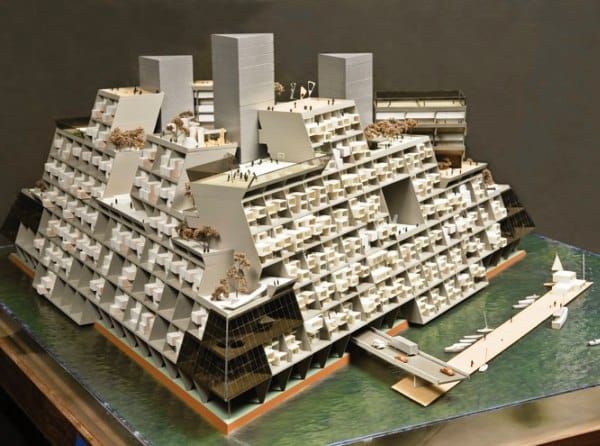
Such has been the vision of many dreamers and architects, like in Jules Verne's 1895 novel Propeller Island. Buckminster Fuller, revolutionary futurist architect and inventor, proposed the idea in his 1968 report, "A Study of a Prototype Floating Community". It was designed to house 5,000 people between a few "towns". The project was originally planned for Tokyo Bay by its original patron, Matsutaro Shoriki. However, Shoriki died abruptly, and the project was picked up by the United States Office of Housing and Urban Development to be constructed in Chesapeake Bay. At first, it had some steam. U.S. bureaus gave the green light and estimated it within 10% of Fuller's own projection. Yet, as is the case with many modern megaprojects in the U.S., administrative instability and bureaucracy led the project into stagnation before it was consequently abandoned.
A common question raised towards floating megastructures is their relation to boats. Indeed, those mega cruise ships are, in many ways, floating megastructures. Nevertheless, a much closer comparison would be a floating deepwater oil rig like that of Thunder Horse PDQ in the Gulf of Mexico. Unlike a cruise ship, these megastructures were built for access, stability, and functionality rather than mobility. The existence of these floating megastructures is ironically the biggest indicator of their stagnation. Oil is a trillion-dollar business. Companies like BP can burn some cash if it means a steady supply of that liquid gold.
Unless a government or ultra-wealthy philanthropist plans on bankrolling a floating city, it cannot happen at the scope architects would like it to. Oceanix Busan is a great example. It has been marketed as a modular floating "city" which is to be completely self-sustaining. In addition to the familiar bureaucracy and legal hurdles (this time in South Korea), the estimated cost keeps ballooning year to year. Further, in an emerging industry where the greatest scarcity is land, the project's buildings are small and the area is open. In short, Oceanix Busan seems to be a utopian money hole. The more I have looked into Triton City, the more I have realized Fuller's genius. Note his design. He maximizes area by building outward and upward. No open spaces and a far greater potential for generating revenue per square foot. Fuller is much smarter than the average architect; he understands the basic economics and designs accordingly.
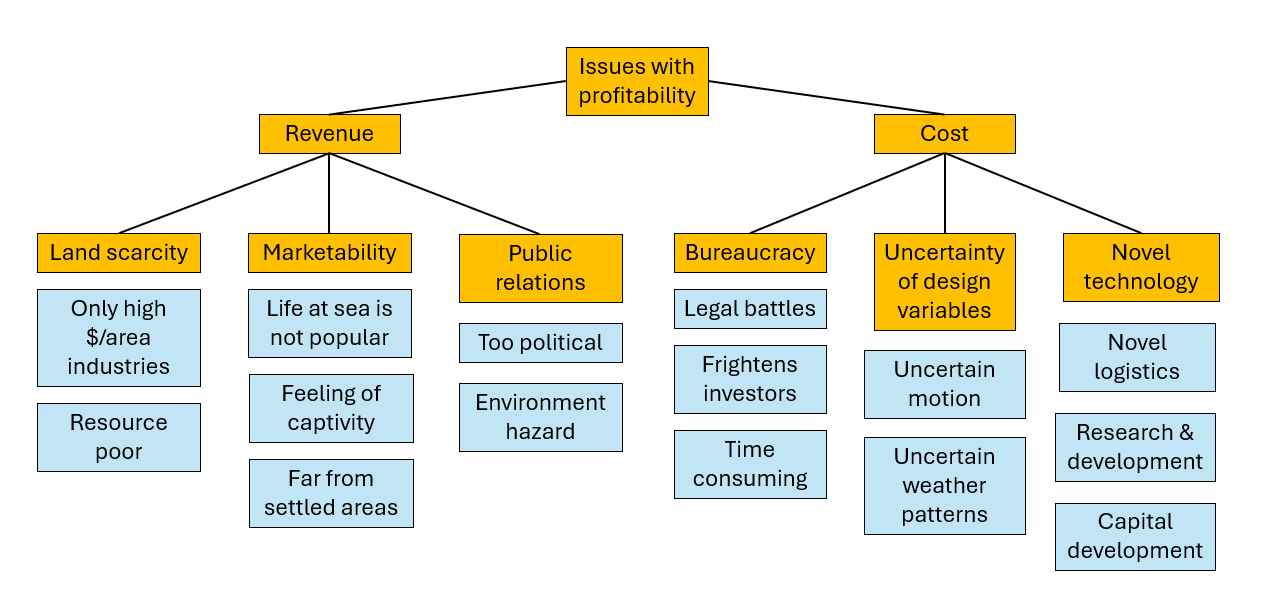
Ultimately, it all boils down to the economics. Revenue is low and costs are high. I broke down the details in the diagram shown below. To see if these issues can be overcome, they must be broken down for further analysis.
Addressing revenues
Land scarcity
The largest dry dock in the world is operated by Hyundai Heavy Industries in Ulsan, South Korea, measuring 672 meters in length and 92 meters in width. An average city block is approximately 60 to 80 meters long. At the current stage, a floating megastructure can only be built to be slightly larger than the average city block if it is to retain a more stable symmetric geometry. At the minimum, we have 8100 square-feet to work with, which could not fit all the necessities of modern civilization: power generation, housing, commercial enterprise, sanitation, shipping, etc. And as mentioned above, few industries have this potential for generating revenue with such a small area of land.
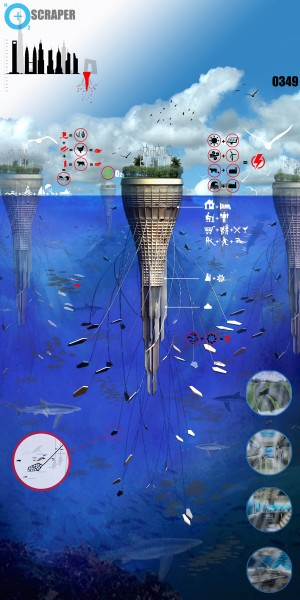
Thankfully, the strength of modern materials like steel and concrete allows us to build vertically, too. Architects like Fuller have proposed building on an upward slope to a plateau. In addition, proposed designs like Water-Scraper build downwards, effectively creating land area while providing a ballast to stabilize the structure. It is necessary to modularize to build out horizontally. By using hinges to connect these floating megastructures together, stress can be reduced at the interfaces (which is particularly important at certain wavelengths) and allow a more elastic response with the waves. Further, theorists have proposed using floating megastructures as a form of "medical tourism". To obtain certain treatments or surgeries, people travel over the world to avoid one country's regulations or standards in favor of others. The healthcare industry is a great example of a high-profit and low-land industry which could take off when put on the water. Further, the recent phenomenon of data centers may pair well with semi-submersible floating structures, allowing them to use seawater as a natural coolant.
Marketability
Ask your family whether they would consider living in an ultra-dense floating metropolis far from existing civilization. Watch their faces go from a romantic to a horrified expression. They imagine being sea-sick, isolated, and claustrophobic with nowhere to run. It doesn't hope that many people exhibit thalassophobia (a fear of large, deep bodies of water) and the fear Cthulhu to awaken from R'lyeh and retake the Earth. Of course, these fears are mostly ungrounded in reality. Floating megastructures would be designed to be near indistinguishable from motionless land, nullifying seasickness. Ideally, megastructures would be stationed close to coastal cities, meaning Denver would probably be further from major cities than a floating metropolis would. The feeling of captivation is only mental, since no one seriously commutes between cities on foot. Granted, claustrophobia is a real concern, but perhaps no more of a concern to those who are already comfortable living in areas like New York City or Chicago.
Future marketers must not only alleviate these fears but provide a good reason for settling. Glorify the open ocean and its beauty. Highlight the clean air. Praise the water activities like sailing, waterskiing, wakeboarding, fishing, scuba diving, snorkeling, and submarining. Most importantly, these marketers must create a romantic status. Like the status of the knight, samurai, cowboy, pirate, or frontiersman, the "sea-settler" is a certain type of person who is pushing boundaries into the future and defining a new generation. In other words, marketers must sell the identity, not just the product. A new Horace Greeley may come along and say, "to the seas, young man".
Public relations
Image is an important and unavoidable aspect of modern business. Unfortunately, the image of "seasteading" has been tarnished with falsehoods and propaganda which has set it back. Patri Friedman and Wayne Gramlich are responsible for founding the Seasteading Institute in 2008, with the mission of fulfilling their "8 Great Moral Imperatives" to Enrich the Poor, Cure the Sick, Feed the Hungry, Clean the Atmosphere, Restore the Oceans, Live in Balance with Nature, Power the World, and Live in Peace. This sounds perfectly reasonable to the median person. However, it was initially funded by never-ending pit of Peter Thiel's money. Thiel, a controversial figure, is the CEO of Palantir and provides surveillance technology for the U.S. government. Patri Friedman, grandson of Milton Friedman, is an anarcho-capitalist who founded the institute. This may be amusing to some but is a red flag to the median person, even though Thiel and Friedman are no longer involved with the Seasteading Institute. What is the result? The Netflix show LOVE DEATH + ROBOTS mocked the idea in one of their episodes as a sort of fallout zone for the wealthiest of snobs, eventually failing because it could not sustain itself. In an episode of Archer, a villain tried to melt the polar ice caps to create his own floating city. And let's not forget Waterworld.
Thankfully, the image is being steadily repaired over time as the Seasteading Institute has become less expressly political and novel architectural designs are emphasizing environmental health (which may not be realistic). As these megastructures become more enticing and seemingly profitable, public image will hopefully improve simply based off of necessity. Every great invention has had its detractors and propaganda once thrown its way.
Addressing costs
Bureaucracy
In my opinion, bureaucracy and regulations are the largest obstacle to the advancement of floating megastructures. As Fuller's design was choked to death by bureaucracy in the United States, Oceanix Busan is currently being choked to death by South Korea. Due to lack of existing standards, many floating megastructures fall under a mix of urban and coastal regulation which is completely inadequate for the novelty of these projects. Bureaucracy and regulations take an enormous amount of time and money to address in legal battles, frightening the few investors who have the means of launching the projects.
While developed economies have grown comfortable enough to stomach tangled and inefficient bureaucracies, developing economies seem to be the best place to build. For example, the Maldives is developing their own floating city which might be the only work-in-progress project that finishes. Prospera in Roatan, Honduras might also shake the field. Prospera is both a governing "platform/service" and private city which was formed as a ZEDE (Zone for Employment and Economic Development). It aims to provide entrepreneurs with the choice of regulation codes and standards under which to develop their product. For example, an entrepreneur might want to choose the Netherlands or Singapore as their framework, and they can do so in Prospera. If approved by the board of Prospera, an entrepreneur may even elect to create his very own code of regulations. Naturally, this might allow entrepreneurs to develop the first floating metropolises in Honduras. It certainly helps that Prospera is a known friend to seasteading and its implied private governance.
Uncertainty of design variables
As engineers, we design for "strength" (will it collapse?) and "serviceability" (will it serve its intended function?). In the case of floating megastructures, we evaluate strength for the structural members under gravity, cyclical wave loading, breaking waves, wind, and others. We evaluate serviceability for the structure against overturning, overtopping, buoyancy, and associated motions (surge, sway, heave, roll, pitch, and yaw) to ensure function and comfort for inhabitants. However, the loads for these floating megastructures are significantly weather-dependent. Unfortunately, weather in open ocean areas is not as precise as we would like it. An engineer would have to look at historical hurricane data to extract wind speed and run it through a few equations to extract a ballpark wave height. Yet, past data is no guarantee of the future. To make matters worse, there are no accurate equations for the force of breaking waves (which are highly non-linear) on structures. Altogether, engineers are pushing data through very conservative equations to create very conservative loads, leading to a classic over-engineered and expensive design.
Thankfully, there is constantly research being done. With the advancement of numerical methods, computational wave simulators have expanded access to researchers across the globe. Currently, I am investigating the effects of breaking waves on various structures using Smoothed-Particle Hydrodynamics (SPH), which is a mesh-free Lagrangian method that discretizes the Navier-Stokes equations to simulate fluid dynamics via particles. Wave and wind data is also being accumulated to grant engineers more precise numbers. Since floating structures in general are a relatively new and niche phenomenon, no decent codes exist to govern design. I hope some engineers will band together to create a comprehensive code to standardize the design of future floating structures while reducing costs.
Novel technology
While various designs of floating megastructures exist today, none of them are suitable for economic habitation. In any case, a design will have to be researched and developed according to numerous constraints. Tech companies are notorious for spending an unreal amount of money on R&D—and the first suitable floating megastructure is no iPhone. The development of this technology will take an enormous team of scientists, structural engineers, naval engineers, construction engineers, and more. Further, designers will have to plan novel short-term and long-term logistics. As someone who is not a construction engineer, I do not have the first clue on how one of these is to be constructed. Long-term, how will maintenance, resupply, and upkeep function? Whatever the answer is, it is bound to be costly until applicable capital is developed.
As with any novel technology, the first is always the costliest. Once R&D wraps up and the capital is constructed, subsequent structures are significantly cheaper as construction speeds up. A megaproject requires investors with a very long-term vision and low time-preference. Finding such an investor in this era of near-zero interest rates is not an easy feat. The first investor will likely have to be motivated by the vision rather than the profit behind it. Think of an Elon Musk type who is enthusiastic to sink a ton of money just to start the process. Or perhaps a major government would be willing to start the process as a national endeavor.
What is misunderstood as a problem
For whatever reason, architects and futurists are completely set on making a floating metropolis become completely self-sufficient. Admittedly, it is a cool sci-fi goal. But what does self-sufficiency actually mean? Production of its own energy, water, food, and resources. Some proposals also want to make a "closed-loop" system whereby even the waste is completely reused. Basic economics teaches us of the benefits of trade. If such a city were to be completely self-sufficient, everyone would be an aquaculture farmer or fisher. I can't imagine how other resources would be acquired. To anyone who is not a starry-eyed architect, the obvious solution is to take advantage of trade and import food, materials, and energy. Never mind the inefficient energy generation technology that has hardly been tested. This does not mean that it should never produce for itself–but allows it to be flexible and pursue higher value goals.
Aligning the stars
According to the discussion above, an ideal project would look like this:
- Modular platforms, each with vertical construction in both directions
- A focus on medical tourism, and possibly oil
- The creation of a romantic image of the sea-settler
- The de-politicization of floating megastructures
- Development in a stable, low-bureaucracy, and low-regulation country
- Further research and testing of design variables
- Development of a structural code
- Development of capital for future projects
- Visionary ultra-wealthy donors, or a government for funding
Will it ever happen? I'll try my best!