Reverse Libertarianism
[On Power]
At one point in time, Nick Fuentes called himself a libertarian. In fact, he partially credits Young Americans for Liberty, of which I worked for, for his initial rise to prominence. He is far from alone. If you have been monitoring the political climate for the last decade, you will surely have noticed the massive re-alignment of the youth "right" from libertarianism to a broader nationalism and Christian conservatism. I attribute three primary factors to this:
- Fizzling of the Ron Paul Revolution, which ended in 2012
- The rise of the culture war
- The immigration crisis
The re-alignment is mostly genuine. Many former libertarians advocate for governance according to Christian morals and national preservation. Among others, I believe they simply wanted to distance themselves from the "libertines", "NAPists", and other unsightly factions of "left-libertarians".
Simply put, libertarianism is not as fashionable as it once was. Regardless, many libertarians have still found great prominence in politics worldwide. Dave Smith is one of the leading figures in U.S. political discourse, U.S. Representative (KY-04) Thomas Massie is more popular than ever, and anarcho-capitalist economist Javier Milei is the president of Argentina (somehow). Conclusively, broader libertarianism is being more embraced while simultaneously being more abandoned. But what do these particular figures have in common? They are all right-libertarians who frame and apply the ideology within the current political paradigm. This makes them relevant. Perhaps not self-aware, they are all followers of what I call "Reverse Libertarianism", which begins with the conception of a free society and evaluates present policy by how closely it approximates that end state, rather than by whether it violates abstract axioms in isolation.
The Non-Aggression Principle
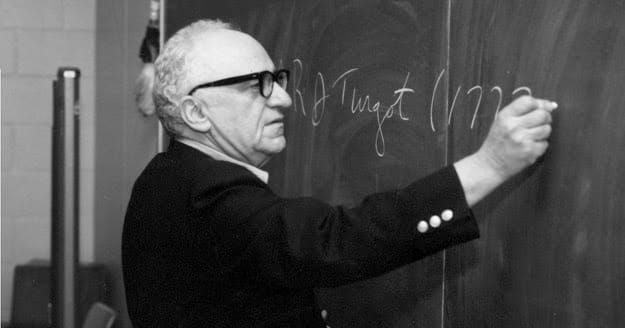
Murray N. Rothbard formulated the non-aggression axiom, later known as the non-aggression principle (NAP), in his 1973 libertarian manifesto, For A New Liberty.
The libertarian creed rests upon one central axiom: that no man or group of men may aggress against the person or property of anyone else. This may be called the “nonaggression axiom”. “Aggression” is defined as the initiation of the use or threat of physical violence against the person or property of anyone.
By extension of this principle, the state is the most dominant and overriding aggressor, using their monopoly on aggression to engage in "legal" plunder.
Libertines and the misinterpretation of the NAP
The NAP is not, and has never been, a strict moral principle. It states that one has a right to be free from aggression, defining aggression by physical violence. The NAP does not state that one ought to be free from moral judgement and scrutiny. You have probably heard something like this before, "libertarianism says that you should do whatever you want." This is the libertine position which has been adopted by many left libertarians. Merriam-Webster defines a "libertine" as such:
a person who is unrestrained by convention or morality
In other words, by conventional libertarian theory, just because you could does not mean that you should (do drugs, engage in pornography, etc.). Libertarianism, at its core, is a legal and ethical framework (not a moral framework). It defines where you have a right of retaliation.
Problems with the NAP
There are many libertarians who treat the NAP as sacrosanct (the "NAPists"), but even most of them will acknowledge the problems with the NAP. In fact, there have been countless debates among libertarian scholars and theorists on what constitutes aggression and what does not.
The stowaway problem is a classic example. Suppose you depart on your ship, only to find out that you have been harboring a stowaway. You are in the middle of the Atlantic Ocean. The stowaway aggressed by trespassing on to your property. Do you have a right to throw him overboard and let him to the sharks? Some would say yes, but that does not mean that it is the moral solution.
Perhaps the largest divide regards immigration. Left-libertarians are notorious supporters of open borders (or "freedom of movement"). Since the state is illegitimate in their use of force, they have no real claim to their borders. For this reason, the left-libertarian says that enforcement of this border is an act of aggression. Earlier in his career, Rothbard believed this too. Later, Rothbard abandoned this position with the likes of Hans-Herman Hoppe to adopt a libertarian position of closed borders, generally arguing that the unwelcome entrance of migrants constitutes an act of aggression. As someone who once believed in open borders, I always found this line of reasoning unsatisfactory. After all, the private property owners still have a right to exclude migrants from their property if they choose.
I present, what I see, is the biggest problem for the NAP, which is my foundation for "Reverse Libertarianism". Given that the state has a monopoly on services of governance, an absence of policies by the state also constitutes as an act of aggression. In short, since the aggression has already occurred via its monopoly, further "aggressions" are elaborated instead of doctrinal. But what constitutes a service of governance? To the chagrin of the NAPists, there is no good answer. It is ambiguous. As it turns out, the world is a lot more complicated than they would like. For this reason, one must have a good understanding of what a free society looks like and think backwards (hence, Reverse Libertarianism). In a previous post, "The four systems of governance", I define the public-state, public-stateless, private-state, and private-stateless systems. In order of compliance with libertarian theory, the private-stateless system reigns supreme, followed by the public-stateless system, private-state system, and then the public-state system (status quo). However, since the public-stateless system does not work at scale, we can generally ignore it within analysis. Within every one of these systems, borders surely exist (except in some extreme exceptions). Therefore, we can rule out the ludicrous idea of open borders. What about laws governing morality? If the U.S. were privately owned, would there be laws against prostitution and drug usage? Likely some. A much better question to ask is...if each state or county were privately owned, would there be laws against prostitution and drug usage? Undeniably for most, but definitely not all. However, in a free society, these issues would be dealt with swiftly and efficiently. Given that we do not live in a free society, this adds in another layer of complication of consider. Since the state is proven to be awful at drug prohibition and suppressing the emergence of a violent black market, what should be done? Again, it's ambiguous.
Re-thinking the NAP
The NAP ought not to be applied to every situation liberally. Doing so inevitably leads you to the disaster of open borders and collapse. Instead, I have found it more useful as a goal. If a free society is one that adheres to the NAP most closely, libertarians ought to support policies which emulate that of a free society, but within the context of the current political paradigm.
A warning to libertarians
Unlike Objectivism, libertarianism is not an all-encompassing ideology, as much as some would like it to be. It does not define moral codes, does not teach you how to live a healthy life, and does not teach you how to be virtuous. If you call yourself a libertarian, ensure that it is not the only thing that you call yourself. Further, welcome the ambiguity I present here. Ambiguity can be a strength. It can open your mind, lead you to some interesting ideas or conclusions, and allow you to stretch across the aisle to other ideologies for a better understanding of the world. Don't box yourself in.
If you are a libertarian, let this reasoning guide you to what many libertarians fear most: relevancy.