What system do we live under?
[On Power]
From "we live in a democracy" to "we live in a republic", both are laughable at best. At one point, we might have lived under one of these. However, both terms have been so thoroughly distorted through years of state and media propaganda, that neither of these terms mean anything anymore. At some point, one has to cut through the dogma and re-dissect the systems of government as they were originally understood.
Aristotle's systems of government
Aristotle is first recognized as identifying six types of government. Of the six, Aristotle recognized three as correct (e.g. serves the "common good"): kingship, aristocracy, polity. The remaining three were recognized as incorrect: tyranny, oligarchy, and democracy. The former three were characterized by virtuous rulers whereas the latter three were absent of virtue. Kingships and tyrannies have a singular leader, aristocracies and oligarchies have a few, and polities and democracies have many (note this is not "all").
According to the American paradigm, "king = bad" and "democracy = good". And in contrast to the "No Kings" rallies which the clueless geriatrics are so fond of, Donald Trump is neither a king (which was understood as "correct") or a tyrant since he does not have unilateral authority, despite the 250 years of growth of executive power. At one point, the United States doubled as an aristocracy of the Virginia elite. These men, including George Washington, Thomas Jefferson, James Madison, Patrick Henry, and George Mason, were the pinnacle of American governance. It is no coincidence that despite the bias of historians, the Virginians consistently rank among the greatest presidents and statesmen. These men, well-read and successful, were actually committed to maintaining a republic and were filtered on land, education, and reputation over modern democracy's charisma, money, and appearances. Americans should lament the fall of aristocracy because instead of Washington, Jefferson, and Madison, we now have Obama, Biden, and Trump.
In fact, the closest systems we live under are a "democracy" and "oligarchy". In practice, our officials are generally elected by a majority (of voters) who are uninformed and base their vote on self-interest and emotion. However, the oligarchy (which is composed of many factions), moves the money around to take advantage of the voters.
What is a republic?
Derived from the Latin term "res publica" (meaning "public matter"), "republic" is actually a fairly loosely defined word. It was originally used by the Romans and doubled as a term to separate public and private ownership ("res privata"). So, in effect, republic just means "publicly owned government". Plato's cornerstone work, "The Republic", was actually originally named Politeia or also "Polity" before being translated. Thus, a republic can either be a polity or democracy depending on the virtue of its people.
Who holds political power?
In a proper republic or polity, the citizenship (stakeholders of the republic) holds all of the political power. However, we do not even have this. Citizenship has been so thoroughly diluted over 250 years that it no longer means anything to be a citizen. Any uninformed and self-interested Joe who has been in the country for a few years apparently has a right to power, so it's no wonder that the citizenship has lost influence to other factions. The recent surge of "populism" is just the relative re-establishment of the weakened citizenship to the factions of oligarchy.
The factions of oligarchy are many. Indeed, most notable of these are the massive corporations and megadonors, including the "merchants of death" and even the Federal Reserve to an extent. However, we must also not forget the influence of various interest groups and unions which have shadowy leaders of immense power. Perhaps the worst of the factions, foreign governments have managed to gain a stake in the United States. While Israel is by far the most notorious and influential, there are endless lobbying efforts from many countries to affect U.S. politics.
While the "boomercon" right likes to ignore the factions of oligarchy, the left likes to conveniently ignore the bureaucracy. The bureaucracy is truly the chaos of cogs in the machine to make everything spin in every direction simply to justify its own existence. Perhaps also known as "the swamp" or even the "deep state", the bureaucracy is this seemingly ever-present and ever-growing force without a face. This includes the IRS, FDA, NSA, FCC, SEC, etc. etc. etc. If you give bureaucratic chaos a firearm, you end up with the most nefarious bureaucracies like the FBI and CIA.
Interactions between the centers of power
As anyone could imagine, a ten-way tug-of-war match in the most powerful government in the history of the world typically does not turn out well. Such was the case in the U.S. intervention in the 2016 Syrian Civil War. The CIA bureaucracy was running a covert program (Operation Timber Sycamore) to train and arm certain rebel groups whereas the U.S. Department of Defense, at the behest of the "merchants of death", armed and supported another force, the "Syrian Democratic Forces (SDF)". These pentagon-armed forces and CIA-armed forces ended up warring with each other, tossing Syrians in the meat grinder and taxpayer money in the woodchipper. All the while, the diluted citizenship would rather not have been supporting a war in Syria in the first place.
What is the United States?
There is no one word to describe it. While nominally a republic (more so a "democracy" in a derogatory way), it is effectively governed by the bureaucracy and competing oligarchic factions. Unfortunately, I do not even think I can include the word "federal" since Washington D.C. has ruled supreme over the states since the Civil War.
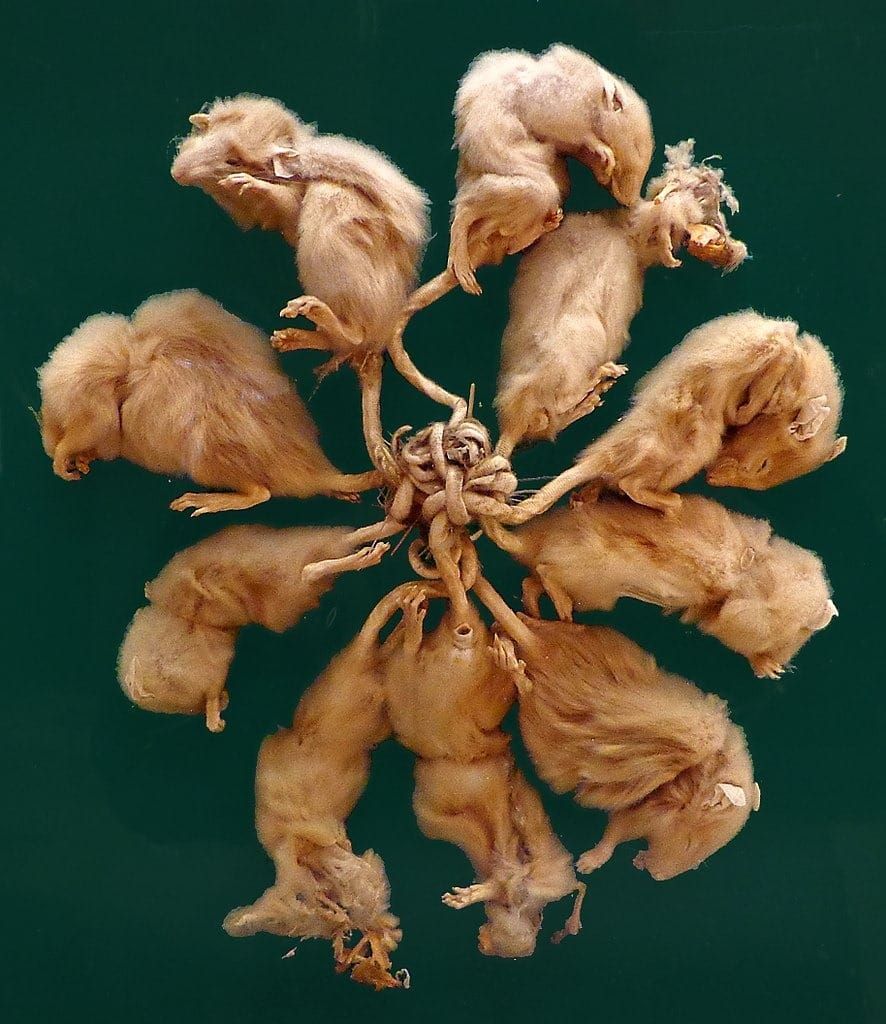
At one point, you could call it a "confederation of polities" and a "federal republic with aristocracy". Now, you could call it a "polycentric oligarchy and bureaucracy over a semi-nominal democracy", but I think the name "rat kingdom" better encapsulates Washington D.C. as the chaotic scurrying of rodents with their tails tied together. Thankfully, "rat-kings" can never live for long.